
Tatsfield BBC Measurement & Receiving Station
Where: Near Tatsfield, Surrey
Built: 1929
Architect: Unknown
Abandoned: c.1974
Listed: No
Visited: 2011
Last Known Condition: Poor; both surviving buildings have suffered from weather and vandalism.
Page Updated: February 2021
The Tatsfield BBC Receiving and Measurement Station was established in 1929 to monitor domestic radio broadcasts, gathering technical data which was used to ensure that radio programming went out on the correct frequency and to the highest possible standards. Situated on an exposed site on the North Downs chosen for its elevation and proximity to London, by 1938 the station was also monitoring news bulletins from several European countries as well as Tokyo and New York.



In the spring of 1939, the British government gave the go-ahead to prepare for war-time monitoring of foreign radio, leading to the formation of the BBC Monitoring service. The outbreak of war in September that year meant that Tatsfield and its sister stations at Wood Norton (Worcs.) and Caversham Park (Berks.) were soon busy gathering news and information.
Wartime operations at the BBC Monitoring Unit were divided into two parts: "M" unit was the conventional monitoring section while "Y" unit, taken over from the military in 1940, focused on enemy propaganda. Staff at Tatsfield were responsible for locating foreign propaganda transmitters and reporting on jamming of BBC and British Government propaganda stations by Axis powers. Technicians also swept the airways carefully for any changes from the norm, which could be an indication of events taking place in or near the studios or transmitters. Vast quantities of data were gathered, much of it being fed directly to the Political Warfare Executive.
Peacetime, however, meant a change of priorities at Broadcasting House: even during the war questions had been raised about the future of Monitoring and in 1947 the Corporation stated that "the future of the Monitoring Service is now under review in the light of peacetime requirements." The budget was cut by around one third, to £300,000 p/a and staffing was reduced by half. Tatsfield would be spared due to its technical role, but its foreign broadcast monitoring operations were to be greatly reduced. Shortly after this announcement, however, the descent of the 'Iron Curtain' over much of Eastern Europe and Asia saw a resurgence of interest in foreign broadcasts. The United States Foreign Broadcast Monitoring Service approached the BBC with a view to sharing information and avoiding duplication and in 1948 a formal agreement was drawn up allowing full exchange of output and shared coverage of broadcasts.
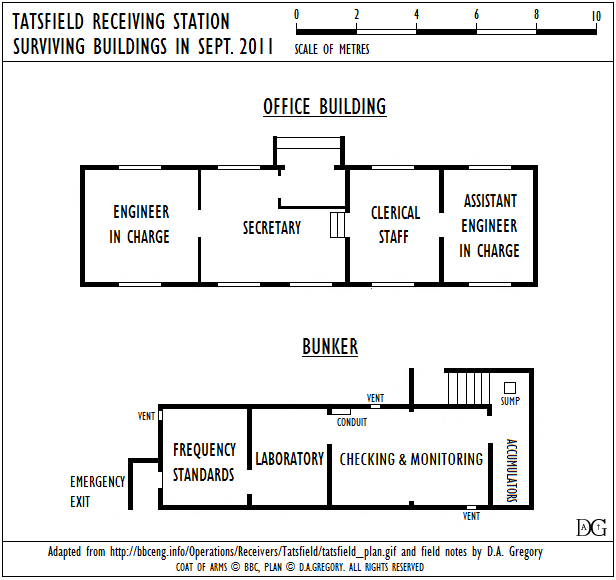
On 4 October 1957 Tatsfield was the first receiver in the United Kingdom to detect signals from the Russian Sputnik I satellite. By 1961 the site included an array of dedicated satellite tracking aerials and covered 40 acres. Other aerials, connected to the main buildings by co-axial cables, received both radio and television broadcasts. Other facilities on site included a large receiving building, a small office block, thermally-controlled underground bunkers housing frequency standards apparatus and radio direction finding equipment, tennis courts, a cafeteria, a social club and a small wastewater treatment plant.
The site is believed to have closed in 1974 when its work was merged with that of BBC Monitoring's receiving station at Crowsley Park in South Oxfordshire. The masts were removed and the site was divided between a local farmer, Post Office Telecoms and British Gas. A BT repeater station was later built on the site of the main block and all of the buildings to the rear of the site were demolished to make way for a new gas valve compound.
Concise Bibliography
Faulkner, Dennis, 2005. 'My life and times as a BBC engineer' [http://www.bbc.co.uk/ww2peopleswar/stories/21/a7157621.shtml] Accessed 06/01/12
Ellen, Martin, n.d. 'The BBC Engineering Measurement and Receiving Station at Tatsfield' [http://bbceng.info/Operations/Receivers/Tatsfield/tatsfield.htm] Accessed 06/01/12
Anon, n.d. 'Tatsfield History Project | Section Five' [http://www.surreycommunity.info/tatsfieldhistoryproject/archive-catalogue/section-five/] Accessed 06/01/12
Anon, March 1961. "The BBC Engineering Measurement and Receiving Station at Tatsfield" London: BBC Engineering Information Dept.
* Archive pictures from Anon, March 1961, "The BBC Engineering Measurement and Receiving Station at Tatsfield" London: BBC Engineering Information Dept. All other archive pictures by and copyright of V. Lehtoranta, all rights reserved. View these pictures full-size at bbceng.info.