|
Bedham Mission Church of St. Michæl and All Angels
Toggle site summary [+/-]
What: Victorian mission church and school
Where: Bedham, West Sussex
Built: 1880
Abandoned: 1959
Listed: No.
Visited: 2010, 2015
Last Known Condition: Ruined, walls shored.
Page Updated: January 2015
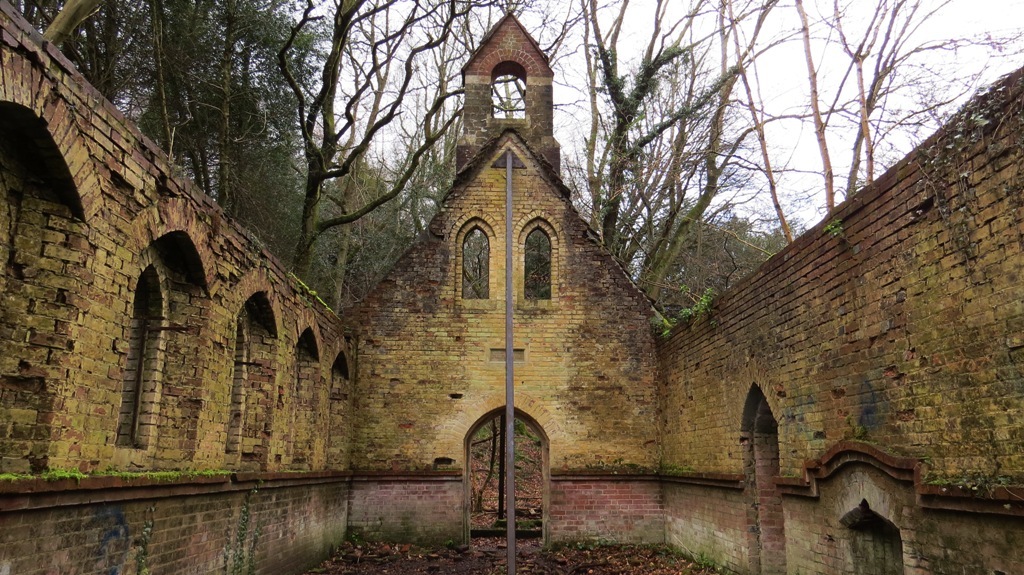
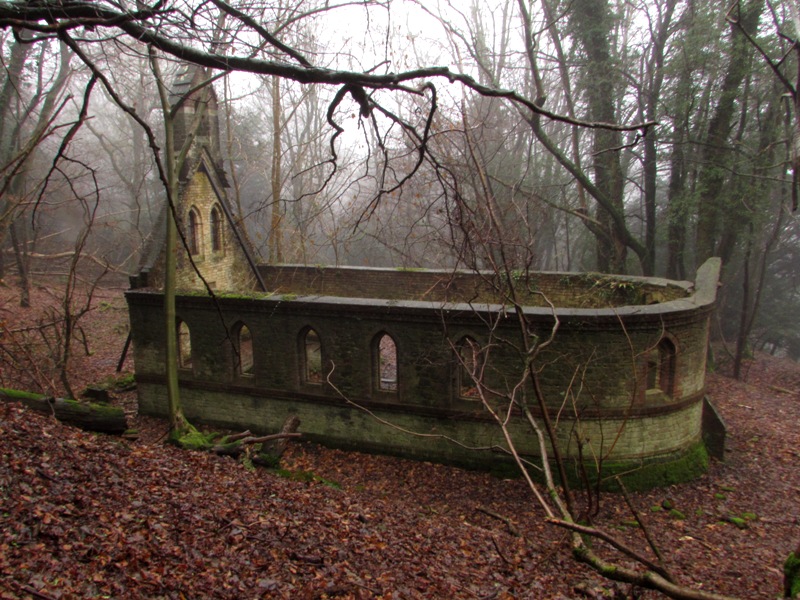
Parking the car in a deserted layby, I followed the single-track road south towards Bedham. A tawny owl called from somewhere down the valley and a fox barked clear and cold in a nearby thicket; no other sound save the wind in the trees. Rounding a bend, a weathercock rose from amongst the trees, then a bell-cote and then there below was the church, standing alone and unroofed.
| |
In the late nineteenth century, the Anglican Church began to make concerted efforts to minister to the poor rural communities of the Sussex Weald: redbrick mission rooms, churches and chapels sprung up in even the most isolated places, attended by families of farmers, woodsmen, bodgers and wood-colliers. Many of these communities were also miles from the nearest school and there was a pressing need, especially after the Elementary Education Act of 1870, to provide adequate schooling. Where children were too few to justify a board school, the Church typically filled the gaps, teaching basic reading, writing, arithmetic and religious instruction.
|
It was against this background that William Townley Mitford (1817-1889), Member of Parliament for Midhurst and Squire of nearby Pitshill House paid for a dual-purpose church and school to be built at Bedham.
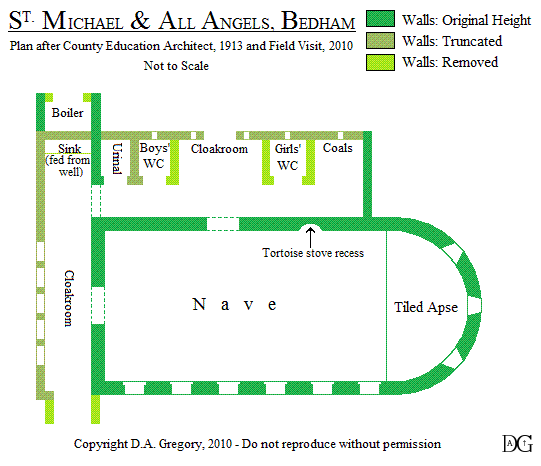
The modest brick building, dedicated to St. Michæl and All Angels, was built in a hollow below the road on a northwest-southeast alignment. A plaque on the north-west wall states that: "FOR THE WORSHIP OF ALMIGHTY GOD/ IN GRATITUDE FOR MANY BLESSINGS/ THIS BUILDING WAS ERECTED BY/ WM. TOWNLEY MITFORD, OF PITSHILL/ ANNO DOMINI 1880."
During the school week, the building was divided in two by a curtain separating infants from seniors; every Friday afternoon, the chairs and desks would be turned to face the altar ready for Sunday service. Worship was led by the Rector of nearby Fittleworth with the master of Fittleworth School serving both as lay reader and headmaster.
Despite the two annual maintenance visits from Mitford's own carpenters, by 1913 the school was found to be in 'a very unsatisfactory state' with 'defective lighting and ventilation' and the girls' earth closet 'very offensive indeed.'
Due to a falling rural population, the school closed in 1925, but the building continued in regular use as a church for a further thirty years. The congregation was never a large one and with the demise of the charcoal industry and the effects of two world wars attendance declined to almost nothing: the last wedding held here was in 1959 and there is no record of any later services.
Bedham itself lies deep within the Western Weald, a tiny hamlet of no more than a handful of houses once inhabited by farmers and charcoal burners. Its tranquility made it a retreat for several artists, writers and composers in the nineteenth and early twentieth Centuries including Rex Vicat Cole (1870-1940), Sir Edward Elgar (1857-1934) Stella Bowen (1893�1947) and Ford Maddox Ford (1873-1939).
The church and surrounding land are now part of a 395 acre nature reserve which is open to the public. If you intend to visit the site, please behave with due respect and consideration and leave it as you found it.
SOURCES
Original documents, catalogues and plans in the West Sussex Record Office, Chichester: AM 73/1; E/86A; Mitford MSS 2268-2273; MP 4045.
P Jerome, (2011) 'Peter Dead Drunk', The Window Press
P Jerome, (2006) 'Petworth from 1660 to the present day.', The Window Press
Valerie Martin, (2004) The Bedham Church Mystery', archived at http://web.archive.org/web/20050416170437/findonvillage.com/0713_the_bedham_church_mystery.htm Retrieved 04.12.09.
Home
| |
The Derelict Miscellany: website and all content © D. A. Gregory unless stated to be otherwise.
|